The Essential Guide to REScheck for Insulation: What Every Utah Homeowner Needs to Know
Building a home in Utah is a significant investment, particularly with the state’s unique climate and evolving energy regulations. Whether you are constructing a custom luxury home in The Cove neighborhood of Ogden or a modern family residence in the Sugar Creek community of Logan, ensuring your structure is energy-efficient is not just a matter of comfort—it is a legal requirement. One of the most critical documents in this process is the REScheck report.
For many homeowners, the term "REScheck" sounds like technical jargon best left to contractors. However, understanding the importance of a REScheck for insulation and the specific data it provides is essential for any property owner who wants to maximize their home’s performance, lower utility bills, and ensure a smooth building permit process.
What is a REScheck?
REScheck stands for Residential Energy Services Check. Developed by the U.S. Department of Energy, it is a compliance software used to determine whether a residential building's design meets the requirements of the International Energy Conservation Code (IECC) or state-specific energy codes.
In Utah, energy code compliance is governed by the state’s adopted versions of the IECC, often with specific local amendments. A REScheck evaluates the "thermal envelope" of your home—the barrier between the conditioned interior and the unconditioned exterior. By analyzing insulation, windows, and doors, the software calculates whether the overall heat loss of your proposed home is equal to or less than the maximum allowed by code.
The Critical Role of Insulation in Utah’s Climate
Utah’s weather is notoriously varied. From the freezing winters in the Cache Valley around Logan to the scorching summer afternoons on the Ogden Bench, your home’s insulation is the primary defense against the elements. A REScheck specifically focuses on the efficiency of this defense.
Understanding R-Values and U-Factors
The core of a REScheck report revolves around two primary metrics: R-value and U-factor.
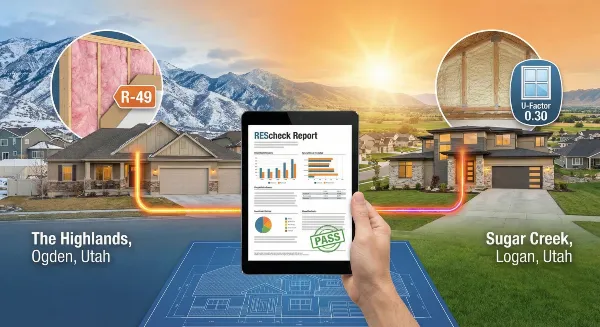
R-value: This measures the thermal resistance of insulation materials. The higher the R-value, the better the material prevents heat from escaping or entering. In northern Utah neighborhoods like The Highlands in Ogden, high R-values in attics and walls are essential for maintaining warmth during heavy snowfalls.
U-factor: Typically used for windows and doors, this measures the rate of heat transfer. A lower U-factor means the window is more efficient at keeping heat where it belongs.
By inputting these values into the REScheck software, builders can prove that the home will perform efficiently under the specific climate conditions of Northern Utah.
Information Provided to Homeowners in a REScheck Report
A REScheck is more than just a "pass" or "fail" grade. It provides a comprehensive breakdown of the home’s energy plan. When a homeowner receives the final document, it usually consists of two main parts: the Compliance Certificate and the Inspection Checklist.
1. The Compliance Certificate
This page summarizes the overall energy performance. It lists the specific R-values for every part of the home:
Ceiling/Roof Insulation: Often requiring R-49 or higher in colder Utah zones.
Wall Insulation: Detailing the cavity insulation and any continuous insulation (ci) required.
Floor and Foundation: Including slab-on-grade insulation or basement wall R-values.
Fenestration: The specific U-factors required for every window and glass door.
2. The Inspection Checklist
This is arguably the most valuable part for the homeowner. It provides a roadmap for the building inspector and the insulation contractor. It lists specific requirements that must be verified on-site, such as air sealing around pipes, the installation of attic baffles, and the sealing of the "rim joist"—a commonly overlooked area where significant air leakage occurs.
The Benefit of the "Trade-Off" Approach
One of the biggest advantages of using a REScheck for insulation planning is the UA Trade-off method. In a prescriptive code, every single component must hit a specific number. However, REScheck allows for flexibility.
For example, if you are building a home in Coldwater Creek Estates in Ogden and you want to install massive, floor-to-ceiling windows to capture the mountain views, those windows might have a higher U-factor (less efficiency) than the standard code allows. To compensate, the REScheck might show that you can "trade off" that loss by installing higher-performing spray foam insulation in the walls or increasing the blown-in fiberglass in the attic to R-60.
This flexibility allows homeowners in Logan’s Sugar Creek or Ogden’s Skyline Estates to maintain their architectural vision while still meeting the rigorous Utah Energy Code standards.
Why a REScheck is Essential for Your Building Permit
In almost every municipality in Utah—from Weber County to Cache County—a REScheck report is a prerequisite for obtaining a building permit. Building officials in Ogden and Logan use these reports to ensure that new constructions won't become a burden on the local energy grid.
Without a passing REScheck, you cannot move forward with construction. For homeowners, having this report early in the design phase prevents "costly design errors." It is much cheaper to change a specification on a piece of paper during the planning stage than it is to realize your insulation is inadequate after the drywall has already been hung.
Long-Term Financial and Comfort Gains
Beyond the legal requirements, the importance of a REScheck for insulation lies in the long-term health of your bank account.
Lower Utility Bills
Utah’s energy prices are subject to fluctuations, and a home that is verified to be energy-efficient will consistently cost less to heat and cool. By ensuring that your home meets the 2021 IECC standards (or whichever version is currently enforced in your specific Utah city), you are essentially "locking in" lower operating costs for the life of the building.
Enhanced Interior Comfort
We have all been in a house where one room is freezing while another is stuffy. This is often due to "thermal bridging" or inconsistent insulation levels. A REScheck forces a holistic view of the home. It ensures that the insulation levels in a home in Deer Crest (Ogden) are balanced across all surfaces, eliminating drafts and cold spots.
Resale Value
In 2026, home buyers are more educated than ever. They look for "green" features and energy-efficient certifications. Being able to provide a potential buyer with the original REScheck report and the accompanying insulation certificates proves that the home was built to high standards. It offers peace of mind that the hidden components—the insulation inside the walls—are doing their job.
Conclusion: A Roadmap to a Better Home
Whether you are nestled in the historic districts of Logan or looking out over the Great Salt Lake from The Highlands in Ogden, your home’s insulation is its most important silent partner. The REScheck report is the document that ensures this partner is up to the task.
By providing a clear set of R-values, allowing for architectural flexibility through trade-offs, and serving as a vital checklist for quality control, the REScheck is an indispensable tool for the modern Utah homeowner. It transforms "energy efficiency" from a vague goal into a documented, verifiable reality.
If you are planning a renovation or a new build, don't view the REScheck as a hurdle. Instead, see it as your roadmap to a home that is warmer in the winter, cooler in the summer, and significantly more affordable to own.
Here is the specific table of insulation requirements for Utah’s primary climate zones. These values reflect the 2021 IECC as amended by the Utah State Energy Code, which became effective in mid-2024.
Keep in mind that while Ogden (Weber County) and Logan (Cache County) are both currently classified as Climate Zone 5, builders in higher-elevation areas nearby may still need to adhere to Climate Zone 6 standards.
Building Comp Climate Zone 3 (So. Utah) Climate Zone 5 (No. Utah) Climate Zone 6 (Mtns)
Ceiling / Attic R-38 R-49 R-49
Wood Frame R-20 or R-13+5ci R-21 or R-15+5ci R-21 or R-15+5ci
Floor R-19 R-30 R-30
Basement Wall R-13 or R-5ci R-15ci or R-19 R-19 or R-15ci
Slab NR (Not Required) R-10 (2 ft depth) R-10 (4 ft depth)
Crawl Space R-13 or R-5ci R-15ci or R-19 R-19 or R-15ci
Fenestration .32 .32 .32
